“I don’t know how to do poetry. I never liked it,’ he said.
“But you love music,” I replied.
“What’s that got to do with it?”
“Poetry is just music where words are your instrument.”
Sometimes, teaching poetry can feel like trying to sell what is perceived to be an old, used car to someone who says they don’t need one because
1.) They lack the driving licence required to drive safely;
2.) They have no need of one, as they cycle everywhere anyway.
The thing is:
1.)A young person’s brain, developmentally-speaking, is absolutely primed-and-wired for musicality (which is to say: they already HAVE their driving license),
2.) I have never met a student who doesn’t LOVE history (which is to say: they absolutely need poetry if they want to ‘see’ and ‘feel’ what those living in other times experienced).
Today is 11th November.
Today, my student and I walked in the footsteps of a soldier.
We didn’t rush: as with producing a fine meal, the hard work is all in the preparation. And, as with cooking and baking, we used our hands.
Beckett said that:
“You’re writing with your hands, not your brain.”
What he meant is:
Writing is a physical act, first-and-foremost.
My student experiences fine-motor difficulties, so we typed our sonnet. But ground was broken from the hands - the fountain pen that my student likes to write with once-in-a-while. He says that my fountain pen brings the paper closer to him.
I leave you with the Petrarchan sonnet we co-composed. I repeat: A PETRARCHAN SONNET! A strict rhyming structure. A syllabic count. He event remembered to include a volta with the concluding sestet.
His final words to me:
“I’ve got that feeling that I get when I know I’ve done something really, REALLY good! Do you know what I mean?”
“Yes…yes, I do.”
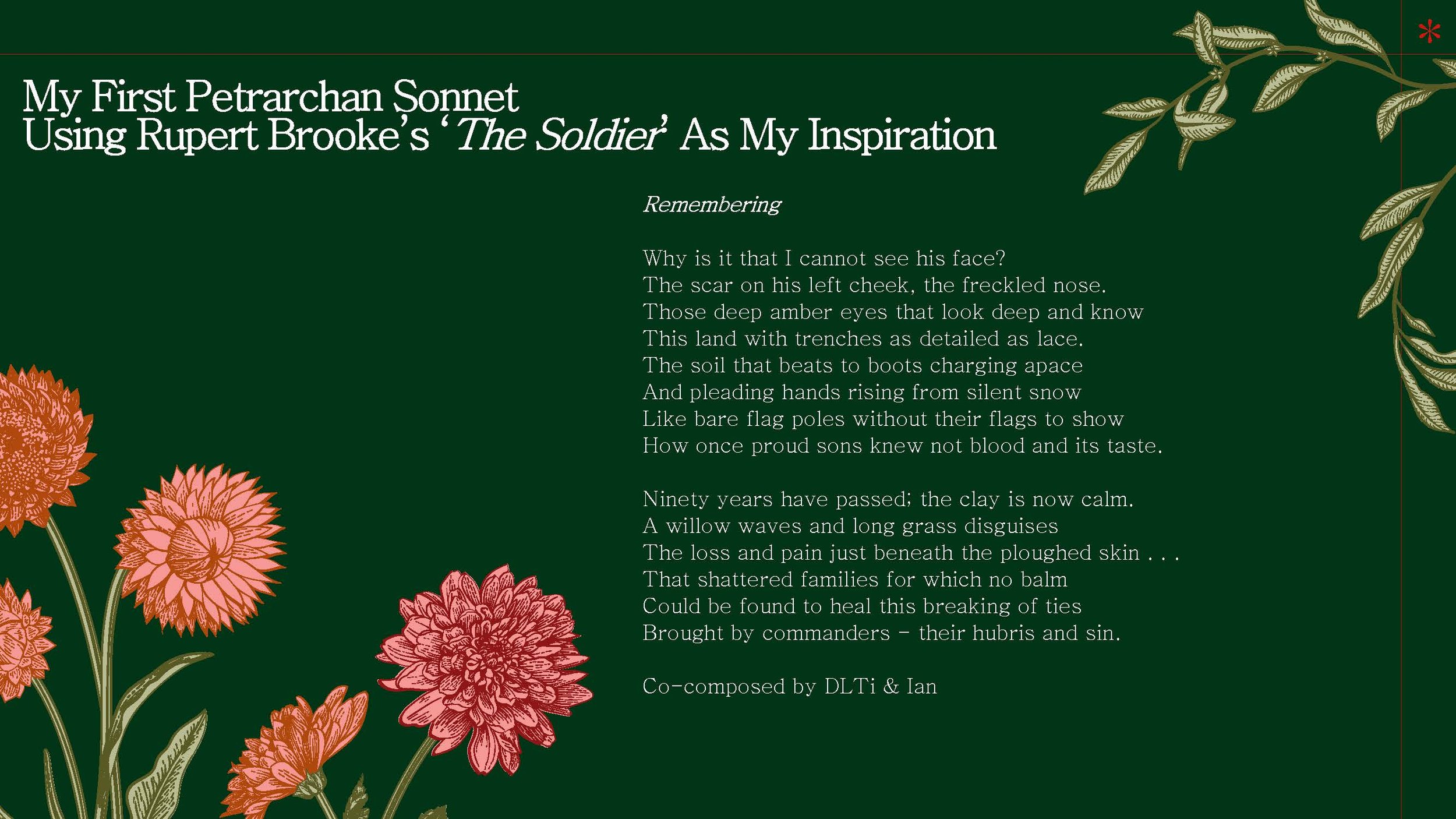
“Remembering” Written by D & Ian (Tutor)
Remembering
Co-composed by D & Ian (Tutor)
Why is it that I cannot see his face?
The scar on his left cheek, the freckled nose.
Those deep amber eyes that look deep and know
This land with trenches as detailed as lace.
The soil that beats to boots charging apace
And pleading hands rising from silent snow
How once proud sons knew not blood and its taste.
Ninety years have passed; the clay is now calm.
A willow waves and long grass disguises
the loss and pain just beneath the ploughed skin…
That shattered families for which no balm
Could be found to heal this breaking of ties
Brought by commanders - their hubris and sin.